Approach

Our approach

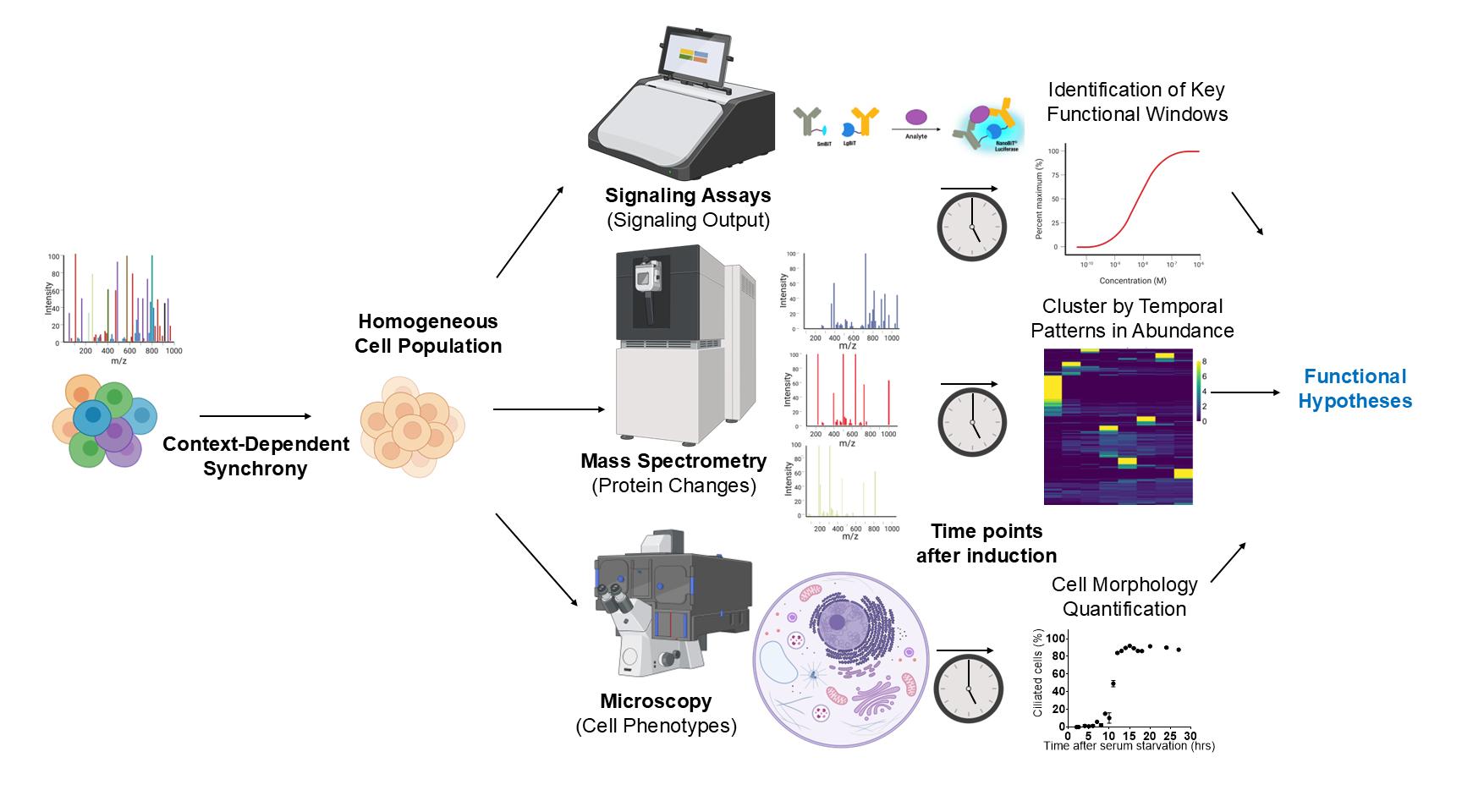
How we resolve signaling in time and space: the pipeline that turns a fate decision into data.

Workflow diagram: a mixed cell population is brought to context-dependent synchrony, then split three ways into signaling assays, mass spectrometry, and microscopy; each is sampled over time to give functional windows, temporal abundance clusters, and morphology quantification, converging on functional hypotheses.
Context-dependent synchrony to functional hypotheses. A homogeneous cell population is read out in parallel by signaling assays, mass spectrometry, and microscopy across time points after induction.
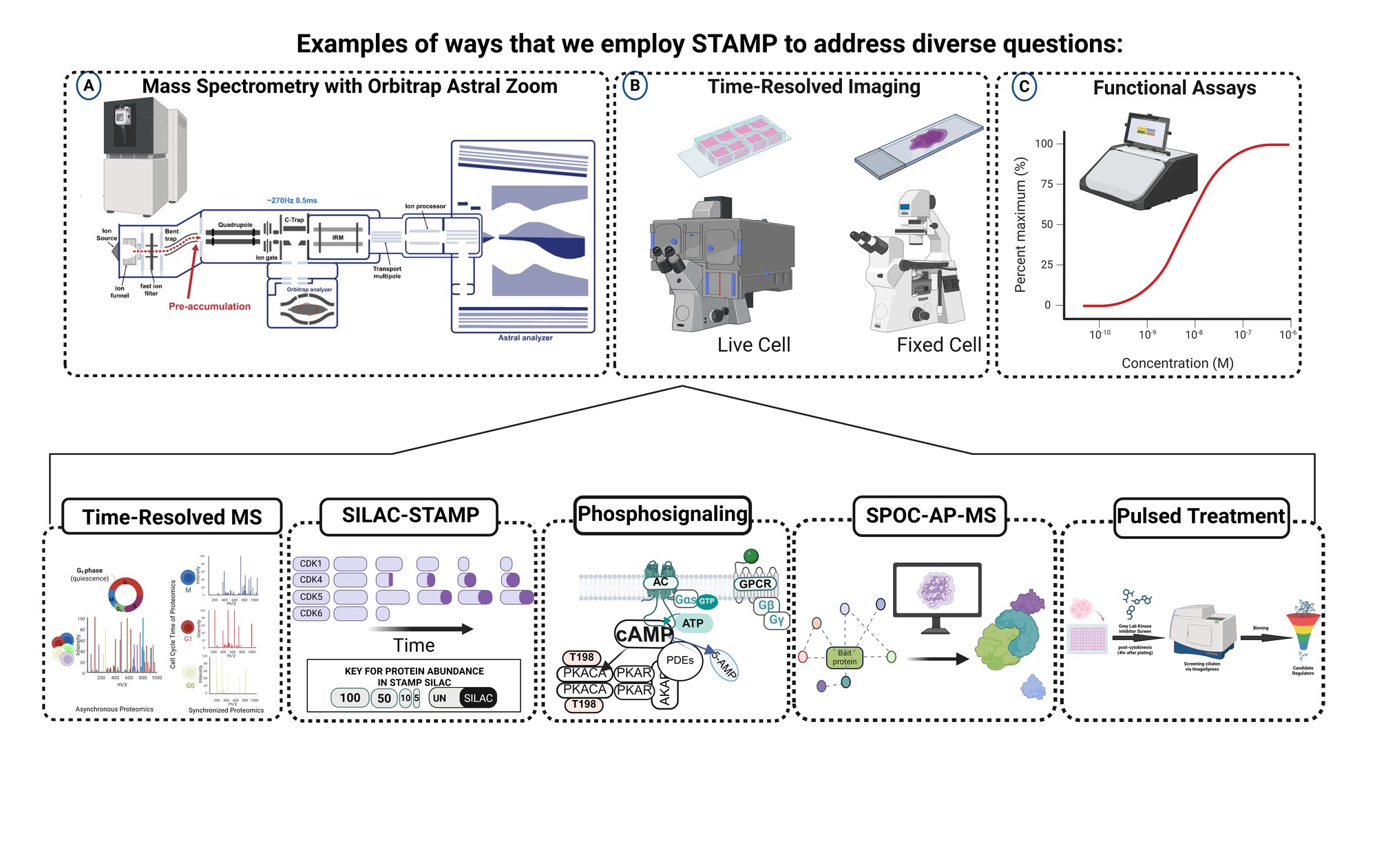
Diagram of STAMP platforms and applications. Top row: mass spectrometry with Orbitrap Astral Zoom, time-resolved live- and fixed-cell imaging, and functional assays. Bottom row: time-resolved MS, SILAC-STAMP, phosphosignaling, SPOC-AP-MS, and pulsed treatment.
Examples of ways that we employ STAMP to address diverse questions.
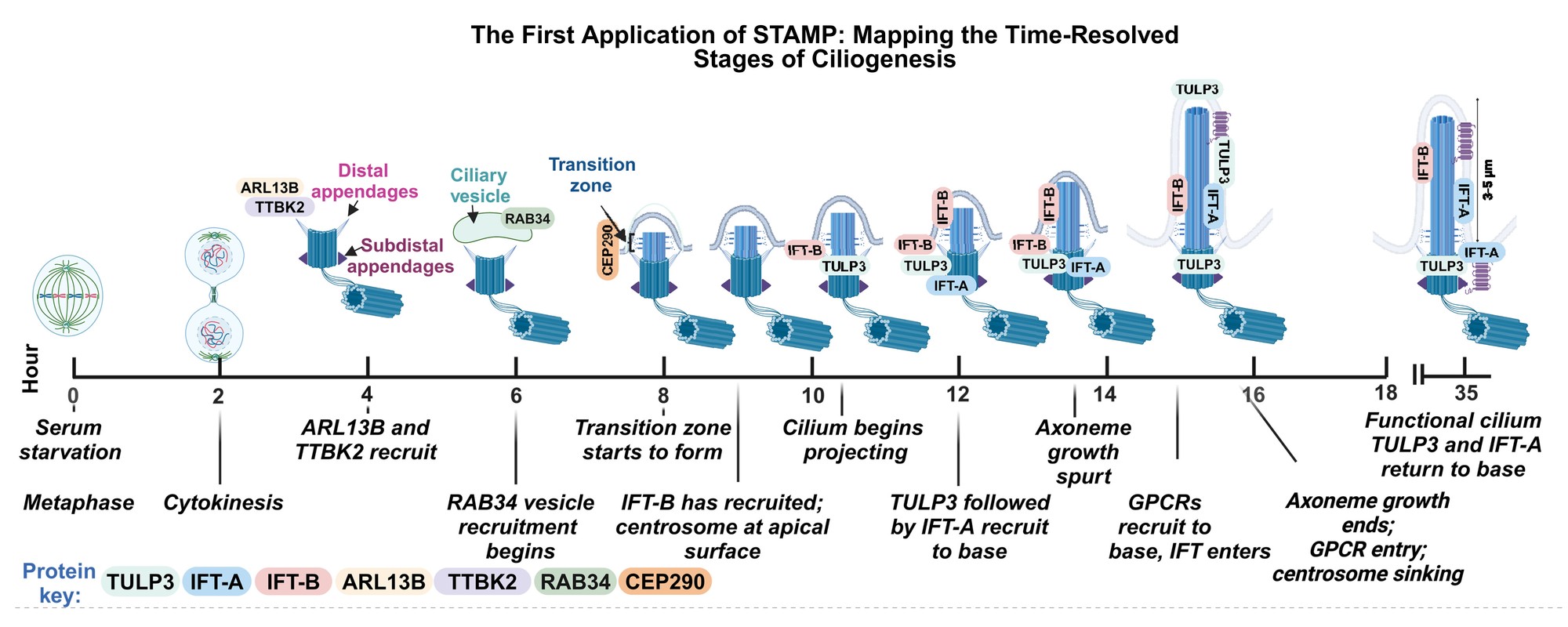
Timeline of ciliogenesis from serum starvation through 35 hours: metaphase and cytokinesis, ARL13B and TTBK2 recruitment at 4 hours, RAB34 vesicle recruitment at 6, transition zone formation and IFT-B recruitment at 8, cilium projection at 10, TULP3 then IFT-A at 12, axoneme growth spurt at 14, GPCR recruitment at 16, and a functional cilium with TULP3 and IFT-A returned to the base at 35.
The first application of STAMP: mapping the time-resolved stages of ciliogenesis.